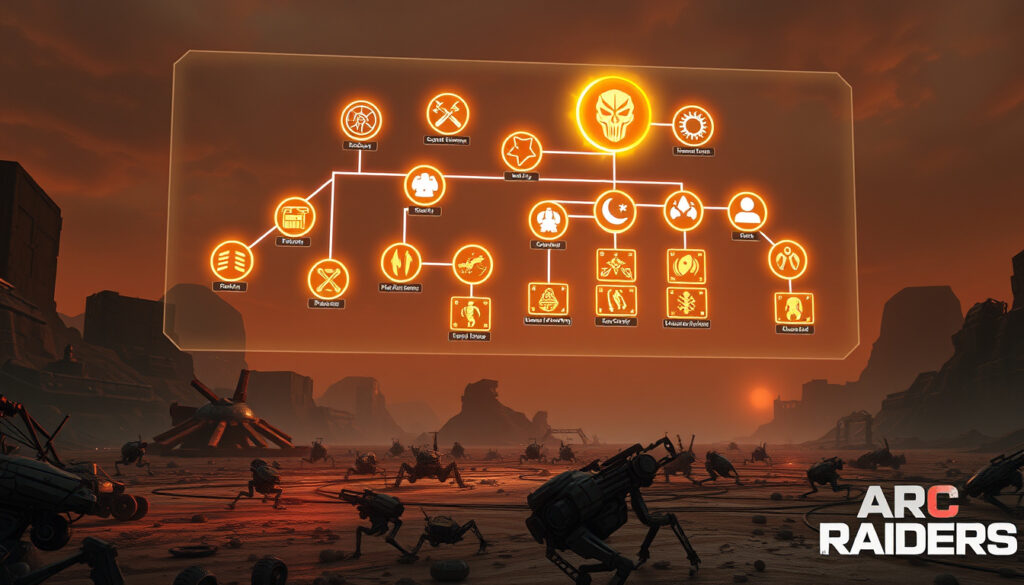
Arc Raiders Skill Tree – Beste Fähigkeiten Auswählen
Arc Raiders Skill Tree: Complete Guide and Analysis
The skill tree system in Arc Raiders represents one of the most ambitious character progression mechanics in the cooperative action RPG genre. As players navigate the post-apocalyptic wasteland alongside their squad, the depth of customization available through this system determines how effectively they can handle the increasingly challenging encounters that await. Understanding the intricacies of the skill tree layout, the synergies between different branches, and the optimal paths for various playstyles becomes essential knowledge for anyone looking to maximize their effectiveness in combat.
The developers at Embark Studios have designed a multi-layered approach to character development that rewards both experimentation and strategic planning. Players who invest time in exploring the connections between different skill nodes often discover powerful combinations that can dramatically shift the outcome of difficult missions. This comprehensive guide examines every facet of the Arc Raiders skill tree, providing the insights needed to make informed decisions about character progression.
The Skill Grid Architecture
At its core, the skill tree in Arc Raiders presents players with a branching network of interconnected nodes arranged in a hexagonal grid pattern. This visual design immediately distinguishes the system from more traditional linear skill trees found in other titles within the genre. The hexagonal arrangement allows for greater flexibility in pathing, enabling players to approach their build development from multiple angles rather than being confined to a single route through the technology tree.
Each node within the grid represents a specific skill or passive enhancement that can be unlocked through the accumulation of skill points. These points are earned primarily through leveling up, with additional points occasionally awarded for completing specific challenges or discovering hidden cache locations throughout the game world. The scarcity of skill points creates meaningful choices, as players cannot unlock every available node in a single playthrough and must therefore prioritize which abilities best complement their preferred combat approach.
The grid itself is divided into three primary branches that correspond to different aspects of combat effectiveness. The first branch focuses on offensive capabilities, enhancing damage output and providing access to devastating special attacks. The second branch emphasizes defensive measures and survivability, offering improvements to armor, regeneration, and crowd control abilities. The third branch specializes in utility and support functions, granting bonuses to mobility, resource management, and team-oriented effects that benefit all squad members in cooperative play.
Key Insights for Build Optimization
Seasoned players have identified several critical strategies for extracting maximum value from the skill tree system. First and foremost, specialization tends to yield better results than attempting to maintain a balanced approach across all three branches. By committing the majority of available skill points to a single branch, players can unlock the powerful capstone abilities that sit at the terminus of each path, whereas splitting points evenly often leaves one stuck with intermediate abilities that lack the transformative impact of their advanced counterparts.
The connection lines between nodes are not merely aesthetic elements but rather represent actual synergies between skills. Some connections provide bonus effects when two linked skills are both active, creating natural build archetypes that the developers clearly intended players to pursue. Recognizing these intended synergies can significantly accelerate the process of developing an effective build, particularly for players who prefer to follow established meta strategies rather than experimentation.
Resource management skills deserve particular attention from players focused on extended gameplay sessions. The utility branch contains several nodes that reduce the cost of ability usage or increase the rate at which essential resources regenerate. These investments often prove more valuable than raw stat increases, especially in higher difficulty content where resources become increasingly strained and every ability activation must be carefully considered.
Skill Tree Comparison
| Branch | Primary Focus | Key Nodes | Ideal For |
|---|---|---|---|
| Offensive Branch | Damage Enhancement | Critical Strike Mastery, Elemental Surge, Devastating Combo | Damage-focused players, speed-runners |
| Defensive Branch | Survivability | Armor plating, Regeneration Matrix, Crowd Control Immunity | Frontline fighters, solo players |
| Utility Branch | Support and Mobility | Resource Efficiency, Team Synergy, Quick Deployment | Support players, cooperative squads |
Detailed Node Analysis
The offensive branch offers three tiers of nodes, with early-tier skills providing incremental damage increases that serve as stepping stones toward the more impactful abilities found deeper in the tree. Critical Strike Mastery, for example, increases the chance of landing devastating blows that deal significantly increased damage, while Elemental Surge introduces elemental damage types that can exploit enemy weaknesses and provide additional status effects.
The capstone ability for the offensive branch, known as Devastating Combo, represents the ultimate expression of damage-focused builds. This ability chains together multiple attacks in rapid succession, with each successful hit increasing the damage multiplier for subsequent strikes. When properly supported by other offensive nodes, a single activation of Devastating Combo can eliminate even heavily armored enemies, making it a sought-after goal for players pursuing aggressive playstyles.
The defensive branch presents an equally compelling progression path, with nodes that address different aspects of character survival. Armor plating increases physical resistance, while the Regeneration Matrix provides passive health recovery that becomes invaluable during extended engagements. The defensive branch also includes unique utility nodes such as Crowd Control Immunity, which prevents enemies from stunning or slowing the player, ensuring they can maintain mobility even under heavy assault.
Progression Timeline
Understanding when specific nodes become accessible helps players plan their progression more effectively. During the early game, the initial nodes in each branch remain unlocked as players reach the required level thresholds. These introductory skills tend to be straightforward stat boosts rather than transformative abilities, serving primarily to familiarize players with the skill tree interface and the mechanics of node activation.
Mid-game progression introduces more complex nodes that interact with player abilities and equipment. This phase typically occurs between levels twenty and forty, where the strategic depth of the skill tree becomes apparent. Players begin to identify their preferred playstyle during this period, often revisiting earlier nodes to adjust their build based on newly discovered synergies or shifting priorities as content difficulty increases.
Late-game character development centers on unlocking and fully upgrading capstone abilities. These powerful skills represent the culmination of a specific branch’s progression path and often define the player’s role within their squad. The investment required to reach these nodes is substantial, typically demanding the majority of available skill points, which underscores the importance of making informed decisions early in the character development process.
Clarity on Misconceptions
Several common misconceptions about the skill tree system have persisted since the game’s launch. Perhaps the most prevalent involves the belief that certain nodes become permanently locked after initial selection. In reality, Arc Raiders allows players to reset their skill tree allocation at designated vendors, enabling complete build changes at the cost of in-game currency. This flexibility means that experimentation is encouraged and mistakes need not derail a character’s long-term potential.
Another misconception concerns the perceived superiority of the offensive branch. While damage output naturally attracts attention, the defensive and utility branches offer equally viable paths to success, particularly in cooperative play where team composition matters more than individual power. Players who struggle with difficult content may find greater success investing in survivability rather than pursuing increasingly marginal damage improvements.
The relationship between equipment and skill tree investments also warrants clarification. Many players wonder whether skill points should be allocated based on their current equipment or anticipated loadouts. The answer lies in finding a balance between immediate effectiveness and future flexibility, with most experts recommending that players focus on universal nodes that remain valuable regardless of specific equipment choices.
Strategic Analysis
The skill tree system in Arc Raiders reflects broader industry trends toward offering players meaningful customization without overwhelming them with excessive complexity. The three-branch structure provides clear delineation between playstyles while the hexagonal grid ensures that no single path feels artificially restricted. This design philosophy extends to the broader game design, where cooperative elements complement individual character development to create a holistic progression experience.
Looking at the competitive landscape, few games in the cooperative action RPG space offer skill tree systems of comparable depth. The nearest competitors tend to feature either more restrictive linear progressions or overly complex web-based systems that sacrifice clarity for freedom. Arc Raiders occupies a middle ground that prioritizes player agency without sacrificing the guided experience that helps newer players find their footing.
The developers have also demonstrated commitment to evolving the skill tree system through post-launch updates. Community feedback regarding specific node balance and accessibility has informed several adjustments, with more changes anticipated based on ongoing player data and competitive analysis. This responsiveness suggests that the current skill tree should be viewed as a living system rather than a static final product.
Community Perspectives
The skill tree is what keeps me coming back. Every character I create feels different, and experimenting with new combinations never gets old.
— Veteran player on official forums
I spent my first thirty levels spreading points everywhere, which was a mistake. Once I committed to the defensive tree, the game completely changed for me. Suddenly I could hold positions that used to overwhelm me.
— Player review on gaming community
Community consensus regarding optimal skill tree strategies continues to evolve as players discover new synergies and techniques. The wealth of shared knowledge available through forums, videos, and social media has created a collaborative environment where build optimization has become a subgenre within the larger player community. New players are encouraged to explore these resources while maintaining awareness that optimal strategies often depend on specific content, team composition, and personal playstyle preferences.
Summary and Recommendations
The skill tree system in Arc Raiders stands as a testament to thoughtful character progression design. Its three-branch architecture provides clear pathways for different playstyles while maintaining enough flexibility to accommodate hybrid builds and experimental approaches. The hexagonal grid visualization enhances usability without sacrificing depth, and the integration of synergy bonuses rewards players who invest time in understanding the underlying mechanics.
For players beginning their journey, the recommended approach involves focusing initially on one branch while maintaining enough flexibility to adapt based on early gameplay experience. The defensive branch offers the gentlest learning curve for new players, providing survivability that can compensate for sub-optimal decision-making during the exploration phase. More experienced players may prefer the offensive branch’s aggressive playstyle or the utility branch’s team-oriented focus.
Regardless of which path players choose, the skill tree system ensures that every character develops a unique identity shaped by countless small decisions accumulated over the course of progression. This personalization represents the core value proposition of the system, transforming what could be a mechanical stat-allocation exercise into a meaningful expression of individual player identity within the game’s cooperative framework.
Frequently Asked Questions
Can I reset my skill tree allocation in Arc Raiders?
Yes, skill tree resets are available at designated vendors throughout the game world. The cost scales with the number of points being reallocated, and the process can be repeated as often as desired. This flexibility encourages experimentation without punishing players for making suboptimal early-game decisions.
Which skill tree branch is best for solo play?
The defensive branch typically proves most effective for solo players, as the increased survivability compensates for the lack of team support. However, skilled players can succeed with any branch by adapting their tactics to their chosen build’s strengths and weaknesses.
Do skill points carry over between different characters?
No, each character maintains its own independent skill tree progression. Players who discover effective builds on one character will need to invest additional time to unlock similar configurations on alternative characters.
Are there any skills that are considered mandatory for all builds?
No universal mandatory skills exist within the skill tree system. Every node serves specific purposes that may or may not align with individual player preferences and playstyles. Players should evaluate each node based on their own priorities rather than following blanket recommendations.
How many skill points can be earned in total?
The maximum number of skill points is determined by the level cap, with one point awarded per level. As the level cap may increase with future updates, the total achievable points can change over time.
Do external links affect skill tree progression?
Equipment with external link properties can modify how skill tree abilities function, adding additional layers of synergy between gear and character development. Players pursuing optimized builds should consider both skill tree investments and equipment properties simultaneously.
Weitere verwandte Artikel
 Tadej Pogačar: Gehalt, Größe, Karriere und aktuelle News
 Wann starb Michael Jackson? Todesursache und Fakten
 Max Langenhan: Olympiasieger und Steckbrief 2026
 Russischer Laden in der Nähe – Beste Empfehlungen vor Ort
 iPhone 16 Pro Max mit Vertrag: Günstige Deals 2024
 Matthias Schweighöfer: Vermögen, Beziehung und Kinder
 Franco Nero: Leben, Filme und Beziehung zu Vanessa Redgrave
 Kikis Kitchen Dubai Schokolade: Kaufen, Preise, Sorten